
What you’ll learn in this guide, in 10 minutes:
- How to calculate the real total cost before you place a bid
- How to reduce the risk of hidden damage on the vehicle
- How to deal with the title (clean/salvage/rebuilt), DMV registration, and insurance
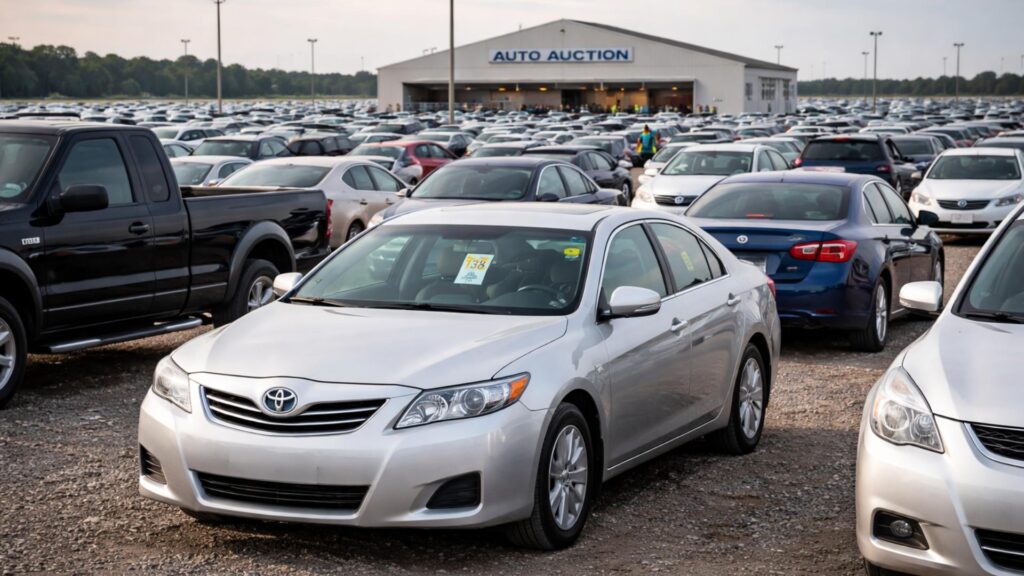
Buying a car at auction in the United States can be a smart way to save money, but only when you treat it as a process (not as a “one-time opportunity”).
The main complaint from Americans is simple:
“My bid was low… but the final cost ended up being much higher than I expected.”
And that happens because, at auctions, the bid amount (the winning bid) is almost never the final price.
You’ll pay auction fees (buyer fee, internet/virtual bid fee, gate/service fee, title-handling, among others), and if you’re late, you can also get charged daily storage fees.
Copart itself recommends paying and picking up quickly to avoid storage, and it lays out the pickup steps and deadlines.
Below, you’ll learn a simple method to set your bidding “ceiling” before you bid, reduce the risk of hidden damage, and avoid headaches with the title (clean/salvage/rebuilt), DMV registration, and insurance.
A simple step-by-step to buy more safely
Step 1 — Define your goal (daily use, resale, parts, or a project)
What are you buying for?
- Daily driver (the most “conservative” option)
- Resale (requires strict math and discipline)
- Parts (a different logic)
- Project (you’re buying risk knowingly)
That choice defines your acceptable risk level.
Step 2 — Understand the auction type and access rules
Some auctions are more geared toward dealers/licensed buyers, while others allow the general public (sometimes through a broker).
Read the rules before getting excited about the price.
Step 3 — Do a VIN check and validate the history the right way
A common mistake is trusting only “a screenshot” or an incomplete history.
The safest path is to check a vehicle history report that uses NMVTIS data a national system created to reduce fraud, stolen vehicles, and title inconsistencies.
The official site lists approved providers and explains what the report helps identify (for example: title brands, salvage/total loss history, etc.).
Practical tip: if your goal is a daily driver, “clean title + consistent history” is usually worth more than “super cheap.”
Step 4 — Read the title like it’s a contract
Look for signs of:
- salvage / rebuilt / flood / total loss
- inconsistent odometer
- history that “disappears” at some point
If you’re not comfortable reading this, treat it as high risk and lower your bidding ceiling.
Step 5 — Treat “as-is” as: “you are the quality control”
When the sale is as-is, where-is, you need to compensate for the lack of warranty with a method:
- study the photos closely (body alignment, airbags, signs of flooding)
- prefer cars with clearer documentation
- avoid impulse bidding just because the auction clock is ticking
“As-is” means exactly that: no promise of repairs afterward.
Step 6 — Plan payment and pickup to avoid storage fees
Another thing that becomes a headache: you win, and then you realize you need to move fast.
Copart advises organizing payment and pickup within a few days to avoid storage fees. IAA also has late payment/storage rules and notes that fees vary by branch.
If you depend on transport, schedule it ahead of time (or have a Plan B). Delays get expensive.
Step 7 — Get an insurance quote and a registration plan before you buy
Many people buy first and only later try to figure out:
- car insurance (especially if the title is branded)
- DMV registration
- state-required inspections
Many DMVs make it clear that salvage/rebuilt vehicles may require specific inspections to be road-legal again.
Step 8 — If you need used car financing, do the math with a clear head
Auctions and financing don’t always mix well, because payment timelines are often short. If you plan to use an auto loan or another form of used car financing, have it approved and aligned beforehand—or choose a path where the timeline is actually compatible.
What goes wrong most often: why the “cheap car” becomes an “expensive car”
1) Auction fees that completely change the math
Large platforms have multiple fees. For example:
- Copart charges a Gate Fee (yard/pickup fee), and its fee page shows amounts and rules that can vary depending on buyer type and scenario.
- IAA (Insurance Auto Auctions) also publishes a buyer fee schedule and mentions charges like internet/proxy bid fee and items like title-handling (and recommends checking storage by branch).
The point is: “auction fees” are not a detail. If you don’t include them in your calculation, you’ll think you won, then find out later you lost.
2) “As-is, where-is”: no warranty, no test drive, and real risk of hidden damage
In many auctions, the car is sold “as-is, where-is”: exactly as it sits, exactly where it sits. In practice, that usually means no warranties and limited inspection; you take on the risk of existing or future issues.
3) Salvage/rebuilt title and DMV bureaucracy
Another common pain point is buying a car with a branded title and only realizing later that:
- getting it back on the road may require DMV inspection, exams, and extra documentation (it depends on the state);
- insurance may be more expensive or harder to get;
- resale tends to be more complicated.
State agencies make it clear that salvage/rebuilt vehicles may require inspection for issuing a new title/registration, as NY and VA explain in their guidance.
The right “ceiling”: the calculation you must do before you bid
Think about it this way: you’re not buying the car at auction based on the bid. You’re buying it based on the Total Landed Cost (the total cost “in your hands”).
Use this total-cost checklist:
- Winning bid
- Buyer fee / auction fees (includes internet/virtual bid fee when applicable)
- Gate fee / service fee / title-handling (varies by platform and buyer profile)
- Local taxes and fees (depends on the state and the vehicle type)
- Transport (auto transport / car shipping): tow truck, carrier, delivery to your address
- Repairs and parts (include a buffer for “surprises”)
- DMV registration + title transfer (and inspections, if needed)
- Car insurance (get a quote before buying, if possible)
Practical rule to avoid traps:
- If you want a car for daily use, prioritize a clean title and a more predictable condition.
- If you’re buying from a salvage car auction expecting big savings, assume part of those savings will turn into repairs + bureaucracy + risk.
A quick calculation model (so you don’t overbid)
Before the auction, write down:
- Maximum market price (or the price that makes sense to you)
- Minus: risk margin + repairs
- Minus: transport
- Minus: DMV/registration/fees
- Minus: auction fees
The result is your bidding ceiling.
And the golden rule: If you can’t estimate repairs/transport with confidence, your ceiling should go down.
Because there are auction fees (buyer fee, internet/proxy bid fee), yard/pickup fees (gate/service), and if you’re late, storage fees. Copart and IAA publish their fee structures and pickup/deadline guidance.
It means you’re buying with no warranties, in the vehicle’s current condition, and you assume the risk of visible or hidden problems.
Use a vehicle history report with NMVTIS data and validate title brands and fraud signals. The official portal lists approved providers and explains what the report covers.
It can be worth it for a project, parts, or a well-calculated resale plan. For daily use, it’s riskier: it may require inspections and bureaucracy to get back on the road, depending on the state.
Yes, depending on the state and the vehicle status (salvage/rebuilt). For example, NY and VA describe inspections for rebuilt/salvage vehicles.
It depends on the platform and the branch, but the standard is only a few days before storage starts. Copart recommends picking up within a few days to avoid fees, and IAA says each branch lists its rules and amounts.
Often, yes. An auction car may not be safe to drive. Plan auto transport / car shipping (tow truck or carrier) as part of your total cost.
It’s not “finding the perfect car.” It’s: calculating the total cost before you bid; doing a VIN check + NMVTIS-based history; treating as-is as real risk and picking up quickly to avoid storage fees.
Conclusion
Buying a car at auction in the U.S. can be worth it, but the secret is simple: you’re not buying based on the bid—you’re buying based on the total cost.
Before you place a bid, add up auction fees (buyer fee, internet fee, gate/service), transport, possible repairs, DMV registration, and insurance, that’s where many people get frustrated because a “cheap car” becomes an “expensive car.”
Then treat the auction for what it is: an as-is, where-is sale (no warranty).
Do a VIN check and, when possible, validate the history with NMVTIS data; and plan payment and pickup within the deadline so you don’t get hit with storage fees.
With a well-defined ceiling and organized logistics, you can buy with confidence and avoid surprises.
Transparency notice
This content is informational and independent.
We have no association with the auctioneers, platforms, or companies mentioned.
Rules, fees, and deadlines can change and vary by state and branch, always confirm details on official sources and the auction terms before you buy.

